

 I am Joe Levitch, owner of Levco Builders, and in my experience, remodeling projects most often fall apart at the final payment. After 21 years in business, we have seen what makes a project end well and what turns a great build into a dispute. The difference almost always comes down to a clear scope of work, changes handled as they happen, and a fair process for working through disagreements. Here is how both sides can get there.
Why the Final Payment Matters
Remodeling is a business of trust. Homeowners trust us with their most valuable asset, and we trust the contract’s payment schedule will be honored. By the time we reach the final payment, the contractor has already carried most of the risk: materials purchased, subcontractors paid, and weeks or months of labor delivered.
A good contract breaks payments into stages that match the project’s needs. The final payment is due when the project is complete, and the contract requirements are met. When a project is built on a mutually signed agreement, that agreement guides both sides.
What “Complete” Should Mean
Most final-payment disagreements start with two people holding two different definitions of “done.” Settle it in the contract before work begins. We recommend spelling out:
- Substantial completion: the point at which the space is usable and the work is essentially finished.
- The punch list: a written list of remaining small items, agreed on at a final walkthrough. Ours is called (FLAIR -Finish Line Action Item Report)
- Final payment terms: what is due at substantial completion and what, if anything, is held until punch-list items are finished.
- Closeout documents: lien waivers, warranty information, and product manuals.
When “complete” is defined in writing, the final payment stops being a negotiation and becomes the last step of a plan you both agreed to.
Withholding Payment Is Not Always Stiffing
To be fair to homeowners, there are legitimate reasons to question a final invoice: defective work, unfinished items, or missing paperwork. Those concerns deserve to be taken seriously and resolved.
The key is how they get resolved. Every contract should include a conflict resolution clause, and both sides should follow it. That means raising the issue in writing, pointing to the specific part of the scope or the quality standard in question, and working through the process the contract describes. What damages projects, and relationships, is withholding payment unilaterally or disappearing from the conversation.
On the contractor side, the same rule applies. If a homeowner raises a legitimate issue, fix it. If you believe the work meets the contract, document why and use the dispute process.
Know Your Contract Type
Price expectations are a major source of conflict, so it helps to understand how a contract is priced:
- Fixed price: the total is set in advance for a defined scope. Changes to the scope change the price, through a written change order.
- Not-to-exceed: the contractor commits to a ceiling price, and the final cost may come in below it.
- Cost-plus: the homeowner pays the actual cost of labor and materials plus an agreed markup or fee. This works best when the scope is hard to define up front, and it depends on transparent tracking of costs.
With a fixed-price or not-to-exceed contract, both sides are bound by the number. If the contractor could not estimate the work accurately, that risk sits with the contractor. If the homeowner changes the scope, the price should change with it, and that change should be agreed to on paper before the work happens.
Defining Quality: Use a Written Standard
When a quality question comes up, “good enough” means something different to everyone. Although not a member of this orginization, we rely on the NAHB Residential Construction Performance Guidelines. They are on their 6th Edition, as a reasonable reference for what is typical in residential work.
To be clear, these are industry guidelines, not law. They apply to a project only if the contract says so. We recommend that homeowners and contractors both ask that a named quality standard be incorporated into the agreement, so that if a question of workmanship arises, there is an agreed yardstick rather than a debate over opinions.
A Word About Liens
In most states, a contractor who is not paid has the right to file a mechanics’ lien against the property. A lien is a legal claim that can affect the homeowner’s ability to sell or refinance until it is resolved. The rules vary significantly by state, including notice requirements, filing deadlines, and how they apply to owner-occupied homes, and the deadlines are often strict.
Contractors should learn their state’s rules before they need them. Homeowners should know that lien waivers at each payment are a standard way to keep the paperwork clean. Either way, this is an area where talking to a local attorney is worth the time.
Homeowner Tips
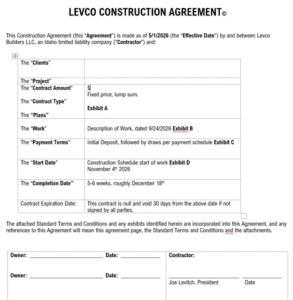
- Invest in the scope of work. A great scope of work (often called a description of work) is detailed, revise it as many times as necessary to make it easy to understand by all parties, and sets the expectation for what is included and excluded.
- Handle changes in writing, as they happen. Both additions and subtractions should be documented in a change order, with the cost and any schedule impact stated, and agreed before the work happens. Waiting until the end is when things get fuzzy.
- Document everything. Keep emails, photos, and signed paperwork in one place.
- Raise concerns early. If something does not look right, tell your contractor right away rather than letting it build.
- Do not alter work in progress. If you do not like something, say so. If the work is changed by someone else before it is complete, it becomes difficult to say who is responsible for the result. Your contract and your state’s rules will govern warranty questions, so ask us how that works before work begins.
- Know your options. If things are going sideways, either side can pause the project to work it out. Ending a contractor relationship is painful, but a pause for an honest conversation is often enough.
- Understand your conflict resolution clause, and follow it.
Contractor Tips
- Be open and honest, including about problems.
- Create a great scope of work and follow it and have it signed.
- Do not assume anything. If a detail was not discussed, ask.
- Write change orders and collect for them before doing the work, not after.
- Be properly Registered, licensed, bonded, and insured, and share that documentation. (again follow local requirements)
- Communicate the schedule clearly and tell clients early when it shifts.
- Respond promptly to concerns and complete the job.
- Have an enforceable contract, reviewed by an attorney in your state.
- Be prepared to pause when things go sideways, then figure it out together.
- Develop a process for closing out a project that is mutually benificial and works, include the details it in your agreement and stick to it.
 If you are ever unsure how to act, the Rotary Four-Way Test is a good compass. Of the things we think, say, or do: Is it the truth? Is it fair to all concerned? Will it build goodwill and better friendships? Will it be beneficial to all concerned?
Lessons From the Field
The handshake contract. A handyman I know took on a larger renovation than he usually does. The scope was loosely defined, and because the client had hired him before, he relied on a handshake. He ended up short $6,000 with no solid paperwork to stand behind. The lesson is for every contractor: the bigger the job, the more the documents matter, regardless of the relationship.
The gutter covers. On one project, a client expected their new gutters to have covers. It had never been discussed, and we had priced standard gutters. We provided the covers at no cost to avoid a confrontation. The lesson is one we apply now: we confirm accessories and upgrades in writing before ordering. Most disagreements about expectations are really gaps in communication, and a line in the scope of work closes them. Be clear about what is not going to happen as well. You know what happens when you assume. This goes for clients and contractors.
Mediators are good to know. There are many ways to do dispute resolution, mediators are trained to help resolve issues. Remodeling happens to be a huge percentage of what they get involved in. Knowing this makes me want to help contractors do a better job of setting expectations for their clients.
How We Keep Projects Smooth
We have learned that a few working agreements make a big difference for everyone. We share them with clients up front:
- Options and selections: we provide options, and you choose. Timely selections keep the schedule on track because delays in decisions can push back the work that follows. If you want to revisit a selection later, we will talk it through.
- One voice: if two people are involved in the decisions, we ask you to choose a primary contact or share a single email address, so we are never guessing whose direction to follow.
- Communication rhythm: we offer a regular check-in, such as a weekly update, so questions have a home. Outside of emergencies, we keep messages to business hours, and we ask that you do the same. It lets our team focus on the work and our families.
- Issues during the project: we want to hear your concerns as they come up. A running list of items to review at the walkthrough is a great way to keep a project moving.
We Are On The Same Team
Remodeling is an intimate business. As Contractors, we are trusted to transform the place where you live, and we take that seriously. Our team gives a lot, because we love the work and we love seeing a client’s reaction when the space comes together. Clear communication and a little appreciation go a long way in bringing out our best. I often say that a “Good job, Joe” is my go juice, and it shows up in the extra care you never see. Having the finish line move is not fun,
The formula for a great ending is simple: define the scope, document the changes, agree on what “complete” means, and use the contract to work through disagreements. Do that, and the final payment is a celebration instead of a fight.
If you are planning a project and want to talk through how we handle scope, change orders, and closeout, reach out to us at Levco. We would love to hear what you have in mind and share best practices.
This article is general information and is not legal advice. Laws about contracts, liens, and payments vary by state. Consult a qualified attorney for guidance on your situation.
Your comments are welcome. To ask questions or get more information about remodeling, click here to email me directly, or call 208-947-7261
If you or someone you know is considering remodeling or would like to speak with a passionate and trustworthy remodeling contractor, please contact us. You’ll be glad you did.






0 Comments